
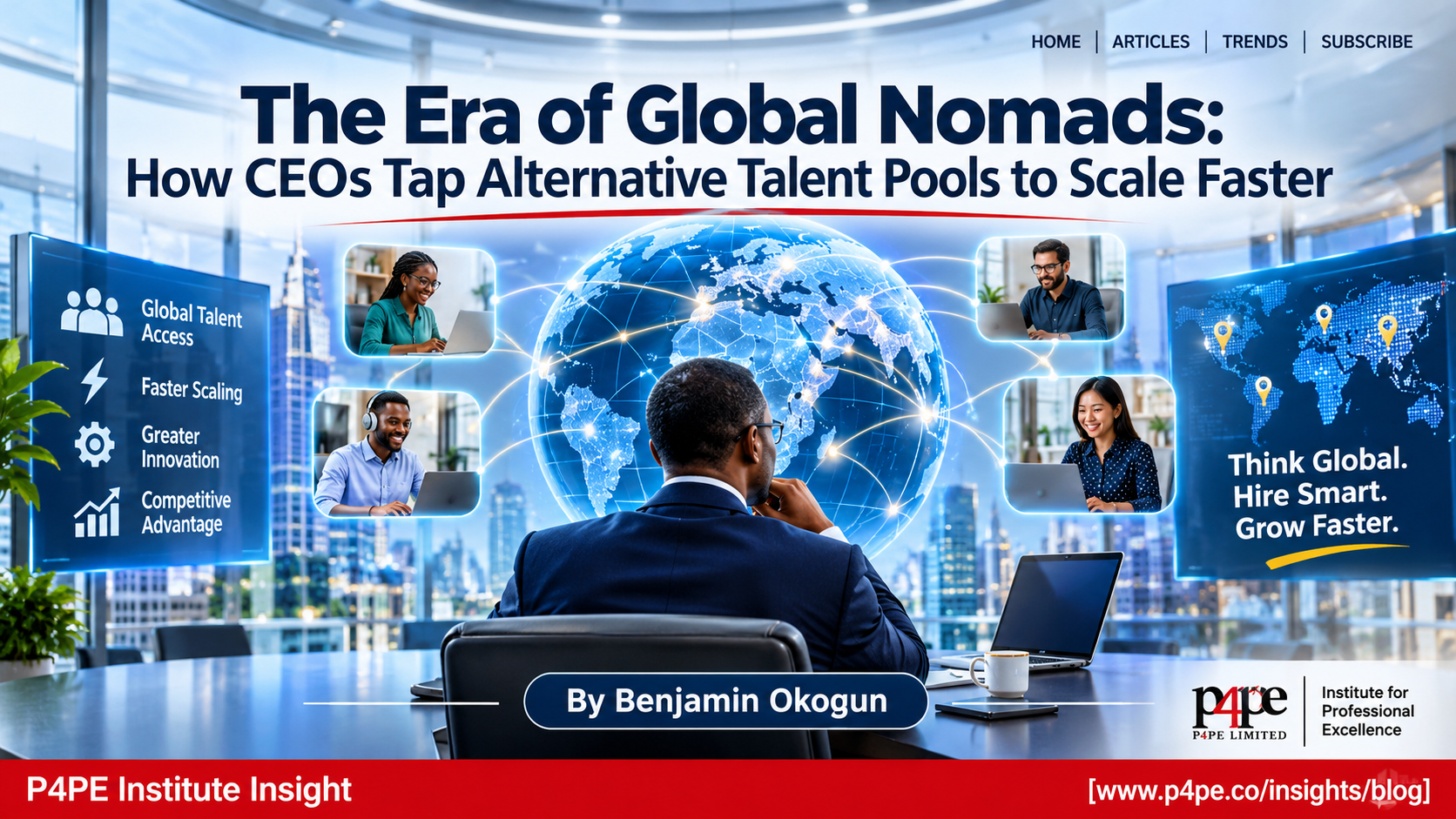
A. CEOs: The talent you need in Lagos isn’t in Lagos anymore.
If your growth strategy depends on finding every specialist within commuting distance of your office, your talent model may already be limiting your revenue, execution speed and EBITDA. The cost isn’t just a vacant role. It is delayed delivery, overstretched teams, missed opportunities and a leadership pipeline that cannot keep pace with expansion.
B. The Expensive Problem
For CEOs and CHROs scaling in Nigeria, talent scarcity is increasingly a strategic constraint. You may find qualified candidates for conventional roles but struggle to recruit experienced cybersecurity specialists, AI engineers, data architects, product leaders, niche finance experts or executives with international market experience.
The consequence is a costly choice: leave a critical position vacant, pay a premium for scarce local talent, or compromise on capability and absorb the performance risk.
The problem becomes more acute when your business requires skills for a specific transformation rather than permanent headcount. You might need a cloud architect for six months, a fractional CFO for strategic oversight, or a global market-entry specialist for a defined project.
Yet many organisations still treat physical proximity as a prerequisite for productivity.
The International Labour Organization’s research on digital labour platforms and the World Economic Forum’s Future of Jobs Report 2025 both point to significant changes in how work is organised and how skills are sourced. The strategic implication is clear: employers need to rethink where talent comes from and how work gets done.
For your board, the question is no longer simply, “Can we recruit this person?” It is, “What is the fastest, most commercially sound and legally compliant way to access this capability?”
C. Why the Old Way Fails
Mistake 1: Treating location as a proxy for capability.
A candidate’s proximity to your Lagos office does not guarantee superior performance. Conversely, an experienced professional working from Nairobi, London, Accra or another market may offer the exact expertise your business needs. Restricting the search unnecessarily narrows the available talent pool.
Mistake 2: Confusing headcount with capacity.
A permanent employee is not always the most efficient answer to a capability gap. If a transformation requires a specialist for four months, a full-time hire may create unnecessary fixed costs after the project ends. The right measure is the business outcome delivered, not simply the number of people employed.
Mistake 3: Treating remote hiring as a technology decision.
A video interview and a signed contract do not resolve tax, employment classification, data protection, intellectual property or cross-border payroll exposure. Hiring globally without a compliance model can turn a promising talent strategy into an expensive legal and operational problem.
The solution is not to abandon local hiring. It is to build a more deliberate portfolio of talent options.
D. The Framework: The GLOBAL Talent Access Model
Step 1: Identify the capability gap before opening the vacancy
Start with the business problem, not the job description.
Which capability is missing? What measurable result must it produce? How quickly is it needed, and what happens financially if delivery is delayed?
Map the requirement against revenue impact, strategic importance, scarcity and expected duration. A role directly responsible for protecting customer data may justify a different sourcing approach from a temporary specialist supporting a product launch.
Use People Analytics to examine vacancy duration, attrition, recruitment costs, productivity and time-to-proficiency. This establishes whether your constraint is genuinely talent scarcity, an unrealistic compensation range, a slow recruitment process or a poorly defined role.
Step 2: Expand the talent map beyond conventional recruitment
Build a sourcing strategy around four alternative talent pools:
- Global remote professionals: Specialists who can deliver defined outputs from their home countries.
- Fractional executives and independent consultants: Experienced professionals who provide expertise part-time or for a defined mandate.
- Diaspora and returning talent: Professionals with international experience, market knowledge and potential connections to African growth opportunities.
- Specialist and project-based teams: External teams engaged for product development, analytics, cybersecurity, implementation or other time-bound work.
Your Executive Search Nigeria strategy should remain connected to the wider market rather than operate as a purely domestic exercise.
Assess each pool against capability, availability, cost, time zone, communication, security and continuity. A global search is valuable only when it improves the quality or economics of the outcome.
Step 3: Select the right engagement model
Not every global professional should be engaged in the same way.
A direct employee may suit a continuing role under your organisation’s management. An independent contractor may be appropriate for genuinely autonomous, project-based services. An employer of record (EOR) may offer a route to employing someone in another jurisdiction where the provider has the necessary legal infrastructure.
However, an EOR is not a universal compliance shield. The appropriate structure depends on the countries involved, the actual working relationship, local employment law, tax obligations and the activities the individual performs.
Before making an offer, assess total cost: compensation, provider fees, taxes, benefits, foreign-exchange exposure, equipment, security and exit obligations. Compare this with the cost of a local hire and the commercial cost of leaving the capability gap unresolved.
Step 4: De-risk the arrangement before onboarding
Create a country-specific compliance checklist covering employment status, payroll withholding, social contributions, immigration and work authorisation where relevant, permanent-establishment risk, and applicable Nigerian and foreign tax rules.
Review data protection obligations, including the Nigeria Data Protection Act 2023 where applicable, cross-border data transfers, access controls, confidentiality and intellectual property ownership.
Define who owns deliverables, where company data may be stored, how access will be revoked and what happens when the engagement ends. Obtain appropriate legal and tax advice before committing to a structure.
Also establish duty-of-care expectations, working-hour boundaries, health and safety responsibilities where applicable, and incident escalation procedures. Global access should not mean unmanaged risk.
Step 5: Manage for outcomes, not online presence
Remote work fails when managers reproduce office-based supervision through constant meetings and activity monitoring.
Set a 30-, 60- and 90-day performance scorecard, with measurable deliverables, clear decision rights and agreed communication routines. Track milestones, quality, responsiveness, stakeholder satisfaction and business impact.
Integrate the professional into the relevant workflows without creating unnecessary meetings or excluding them from decisions. Use secure collaboration systems and AI-enabled workflows where they improve documentation, knowledge transfer or delivery—not as substitutes for sound management.
Review performance and compliance together. The objective is sustainable capability, not merely a faster hire.
E. What Good Looks Like
Imagine a Lagos-based fintech preparing to expand into two African markets. Its product roadmap is stalled because it cannot recruit a specialised data architect locally within its required timeframe.
Rather than lower its technical standards, the company evaluates a global remote specialist for the initial architecture, engages local professionals to support implementation, and assigns an internal executive to own delivery.
Before onboarding, it verifies the engagement structure, tax and data obligations, security controls and intellectual property terms. The specialist works against a defined 90-day scorecard, while knowledge transfer builds internal capability.
The company gains access to scarce expertise without automatically creating a permanent overseas position. The result is a more flexible talent model, provided the commercial and compliance assumptions are validated.
F. The Executive Takeaway & CTA
Your talent strategy should be designed around the capabilities your business needs, the outcomes it must deliver and the risks it can responsibly manage.
For CEOs, this means more sourcing options, better deployment of scarce skills and a stronger connection between workforce decisions and commercial performance. For CHROs, it means evolving from vacancy management to strategic talent architecture.
Global Mobility and remote workforce design are no longer peripheral considerations. They are increasingly relevant to how ambitious African businesses compete, innovate and scale.
To help you identify alternative talent pools and assess the risks before engaging them, P4PE Institute has developed the Global Nomad Talent Pool Sourcing & Compliance Checklist.
Request the resource by emailing P4PE Institute or commenting TOOL on the LinkedIn post. Use it to structure your next talent-access decision before the vacancy becomes a business bottleneck.
