
A. Scaling from 50 to 500 staff? This is where most African companies break.
Revenue can scale faster than the systems supporting it. For the CEO, that means P&L pressure; for the CHRO, attrition and leadership-pipeline risk; for the CFO, rising control and compliance exposure. Growth without organizational capacity eventually turns yesterday’s success into tomorrow’s cost of failure.
B. The Expensive Problem
The transition from founder-led business to professionally scaled enterprise is rarely just a headcount problem. At 50 employees, the founder can still approve exceptions, resolve conflicts and personally monitor critical decisions. At 500, those same practices become bottlenecks.
The cost shows up in places the monthly management report may not immediately connect: duplicated roles, slow decision-making, inconsistent customer experience, preventable turnover, weak middle management and uncontrolled operating costs.
The African operating environment adds complexity. Companies may be expanding across cities and countries while dealing with fragmented labour markets, regulatory requirements, currency volatility and uneven management capability.
The World Bank has repeatedly identified productivity and human-capital constraints as significant challenges to business growth across Sub-Saharan Africa. For a scaling company, the implication is practical: your growth model must scale organizational productivity, not simply payroll.
Revenue per employee, leadership span, time-to-productivity and management cost therefore belong in the board conversation alongside revenue growth and EBITDA.
C. Why the Old Way Fails
1. You add people before redesigning the operating model.
A new branch, product or market creates new work, so the instinct is to hire. But if processes, decision rights and technology remain unchanged, headcount increases faster than productive capacity.
2. You promote yesterday’s high performers into tomorrow’s leadership roles.
Technical excellence does not automatically translate into the ability to manage managers, allocate resources or lead through ambiguity. The result is often a leadership pipeline full of specialists and short of enterprise leaders.
3. You measure activity instead of organizational capacity.
Headcount, training hours and recruitment numbers tell you what happened. They do not tell you whether the organization can absorb another 100 employees without increasing risk.
This is where HR Transformation becomes a business issue rather than an HR initiative.
D. The Framework / The Fix
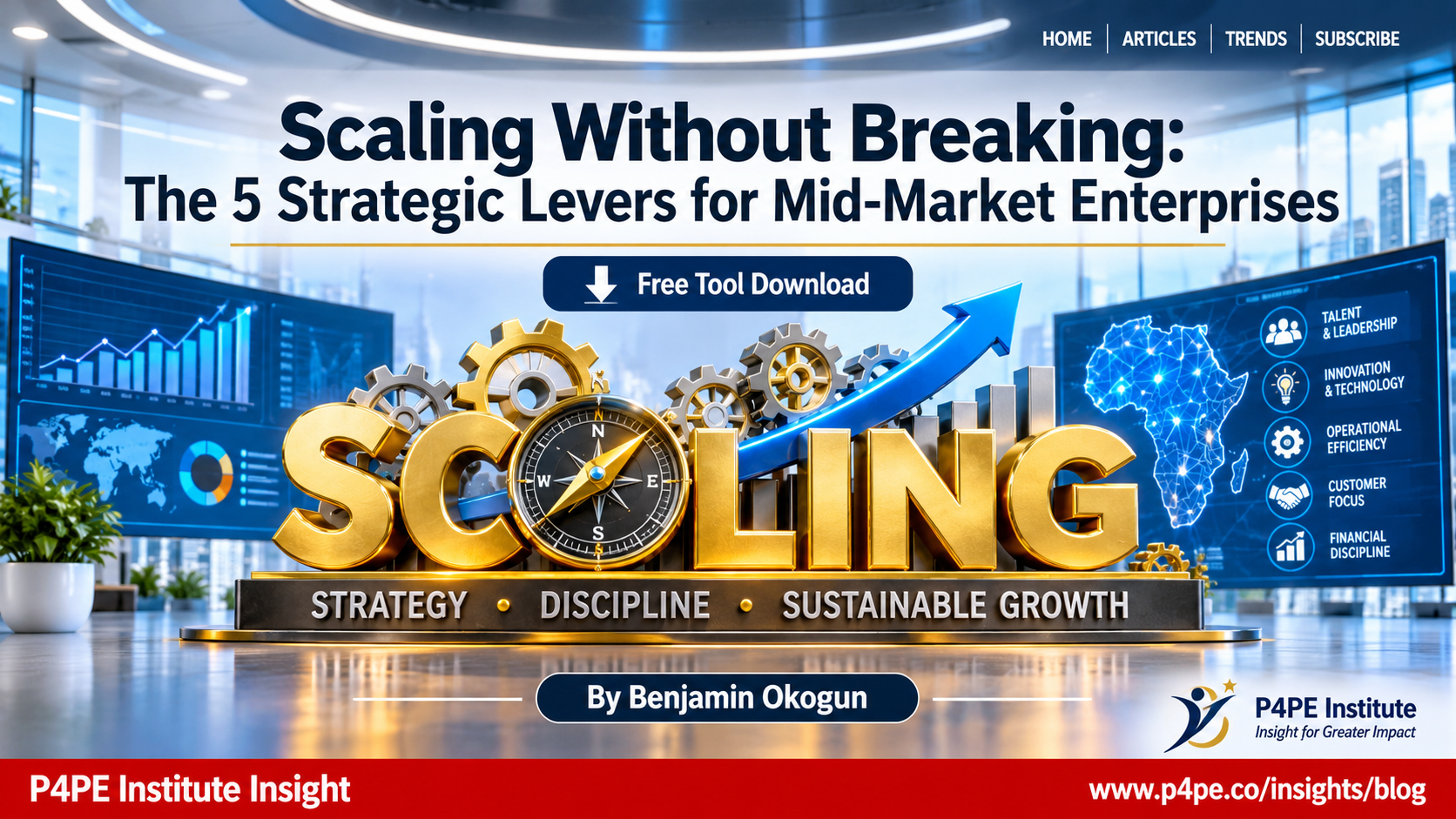
Scaling requires five strategic levers pulled together—not sequentially.
Lever 1: Redesign the Operating Model
Before adding another layer of people, map how value actually moves through the business.
Clarify:
- Which decisions belong at board, executive, functional and frontline levels?
- Where are approvals unnecessarily concentrated?
- Which activities should be automated, outsourced or eliminated?
- Where does accountability become unclear between functions?
Your objective is simple: increase organizational capacity before increasing organizational complexity.
A useful test is to compare revenue growth with headcount growth. If revenue rises 40% while headcount rises 70%, ask what structural issue is driving the gap.
Lever 2: Build the Leadership Pipeline Before You Need It
A company moving from 50 to 500 employees cannot depend indefinitely on the founder or a handful of trusted executives.
Identify the leadership roles required at the next stage—not just those required today.
Build succession depth around:
- critical roles;
- readiness of identified successors;
- capability gaps;
- internal versus external talent requirements;
- time required to make successors ready.
This is where Executive Search Nigeria can complement internal development: not as a substitute for leadership development, but as a mechanism for closing capability gaps when the required expertise is unavailable internally.
Lever 3: Engineer a Scalable Performance System
At 50 employees, informal accountability can work. At 500, it becomes inconsistent.
Create a clear line of sight:
Strategy → Enterprise priorities → Functional outcomes → Team KPIs → Individual accountability
Then measure more than financial performance.
Track revenue per employee, productivity, regrettable attrition, time-to-productivity, leadership coverage, customer metrics and critical-role vacancy exposure.
The goal is not more dashboards. It is faster management decisions based on reliable signals.
Lever 4: Digitize the People and Operating Infrastructure
Scaling exposes weak systems.
Manual recruitment tracking, disconnected payroll, spreadsheet-based workforce planning and fragmented employee data become expensive when multiplied across hundreds of employees.
Build an integrated data architecture covering workforce, performance, recruitment, learning and organizational structure.
Use People Analytics to identify patterns before they become expensive problems—for example, whether attrition is concentrated in a particular manager population, location, tenure band or job family.
AI should augment this system, not replace managerial judgment.
Lever 5: Protect Culture Through Deliberate Governance
Culture does not survive scale automatically.
The founder’s values must become observable management practices: how decisions are made, how performance is rewarded, how misconduct is addressed and how leaders are held accountable.
Document the non-negotiables.
Then reinforce them through leadership appointments, performance management, promotion criteria, governance mechanisms and communication.
The objective is not to preserve the culture of a 50-person company. It is to translate its strongest principles into an enterprise capable of operating at 500.
E. What Good Looks Like
Consider a fintech expanding from 80 to 300 employees across Lagos and other African markets.
Instead of simply recruiting ahead of projected demand, leadership redesigns decision rights, identifies critical leadership gaps, establishes KPI cascades, integrates workforce data and formalizes cultural expectations.
The result is not merely a larger workforce. Management gains greater visibility into productivity, leadership capacity, attrition risk and operating bottlenecks—giving the board a clearer view of whether growth is creating enterprise value or organizational fragility.
F. The Executive Takeaway & CTA
Scaling is not successful because you reached 500 employees.
It is successful when your operating model, leadership capacity, performance architecture, technology and culture can support 500 people without multiplying risk faster than value.
That is the difference between growing a company and building an institution.
To help you assess whether your organization is structurally ready for its next growth phase, we built the Scaling Readiness Assessment: 5 Levers Scorecard.
It gives CEOs, CHROs and CFOs a practical way to assess the five levers, identify pressure points and prioritize the areas requiring executive attention.
Comment TOOL and we’ll send it to you.
