
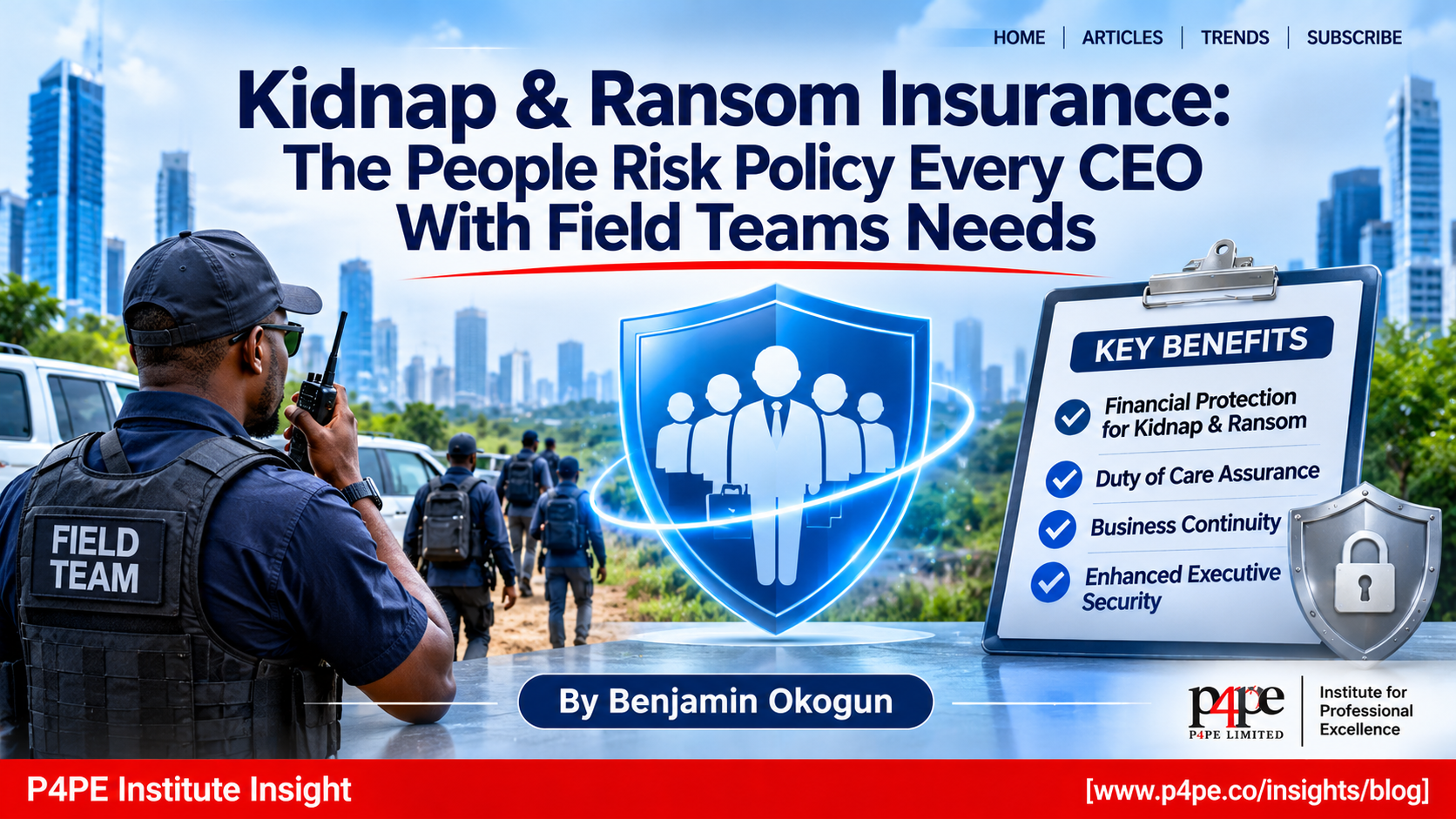
Kidnap & Ransom Insurance: The People Risk Policy Every CEO With Field Teams Needs
A.CEOs with field teams in high-risk regions: do you have K&R coverage?
If an executive is abducted tomorrow, your board will ask who authorises, who negotiates and who pays. Most standard programmes answer none of the three. Inaction turns a security incident into an uninsured liability, plus a duty-of-care claim.
B.The Expensive Problem
Kidnapping is now a measurable operating risk in Nigeria. SBM Intelligence recorded 7,825 abductions between July 2025 and June 2026, up 66% on the prior year, with at least N7.78 billion paid in ransom and 1,142 people killed.
Your exposure is not confined to the North. Southern states still recorded 491 victims, and earlier SBM editions placed Abuja and Lagos among the highest ransom demands.
Ransom is only one line on the invoice. Add crisis consultants, legal counsel, medical and trauma care, evacuation, lost executive time and stalled project delivery, and a single incident can reach your EBITDA.
Meanwhile, your property, health and group life policies probably exclude kidnap, extortion and wrongful detention. That gap sits unpriced and unreported to your board.
It is a compliance exposure as much as a financial one: if an employee is taken, the first question is whether you discharged your duty of care.
C.Why The Old Way Fails
Three assumptions leave most executive teams uninsured and unprepared.
1. Assuming existing cover responds. Group personal accident and travel policies typically pay for injury or death, not ransom, negotiation fees or the cost of a prolonged detention. Few leaders read the exclusions until a claim is declined.
2. Treating it as a security purchase. Procurement or the security head buys a policy in isolation. HR, Legal, Finance and the board never agree who authorises travel, who speaks to the family or who approves a payment.
3. Insuring the expatriate and ignoring the national. Local executives, drivers and field staff face the same threat, often with less protection. Cover that excludes them creates a two-tier duty of care and a reputational problem.
Analytically, this is an unmodelled tail risk: low frequency, high severity, absent from your risk register. The result is either no policy, or one that fails in the first 72 hours.
D.The Fix: A Five-Step Special Risk Framework
Treat special risk cover as a system, not a product purchase. Five steps take you from blind spot to board-ready control.
Step 1: Map the exposure. List every person, route and location where your teams operate: expatriates, field executives, site engineers, drivers and short-term visitors. Include contractors and consultants; they are often the least visible and least covered. Score each by destination threat level, travel frequency, visibility and seniority. Use your People Analytics data, travel bookings and HRIS records, so the map takes days, not months.
Step 2: Audit what you already hold. Pull every policy: property, group life, personal accident, health, travel and D&O. Highlight exclusions for kidnap, extortion, detention and threat to life. Ask your broker to confirm in writing, not by phone. Identify which Global Mobility populations sit outside every schedule. The output is a gap register signed by Finance and Legal.
Step 3: Structure the cover. A credible special risk policy addresses ransom and extortion payments where lawful, crisis response consultants on retainer, legal and negotiation costs, medical and psychological aftercare, loss of income, family support and wrongful detention. Check the policy’s territorial scope, waiting periods and who may be named as an insured person. Set limits against your worst credible scenario, not the cheapest quote. Obtain counsel’s opinion on how Nigerian anti-terrorism law affects ransom payments before you bind.
Step 4: Build the response protocol. Insurance pays after the event; protocol shapes the outcome during it. Appoint a crisis committee (CEO, CFO, General Counsel, CHRO), a 24-hour response line, and one rule for communicating with families and media. Keep policy details confidential, as insurers expect. Name who authorises travel to red-zone locations.
Step 5: Test, measure and report. Run a tabletop drill twice a year and record time-to-activate. Track three metrics: coverage ratio (exposed roles insured ÷ exposed roles total), policy-gap count, and drill response time. Add the risk to your enterprise risk register and report quarterly to the board risk or audit committee. Re-price whenever your footprint changes.
Done well, the exercise also exposes who in your organisation is travelling without anyone knowing, which is a data problem before it is an insurance problem.
E.What Good Looks Like
Picture a fintech scaling to 300 staff in Lagos, with sales and engineering teams travelling to Abuja and the Niger Delta. The audit finds its group policies exclude kidnap and detention. Within six weeks, it binds a special risk policy covering expatriates and Nigerian staff alike, retains a response consultant and drills its crisis committee.
The board risk committee now sees a 100% coverage ratio for exposed roles and a named owner for every response decision. Best-in-class firms go further: they review cover each time a new market opens, so protection scales with revenue rather than lagging it.
F.The Executive Takeaway
The board-level outcome is simple: a known, priced and governed tail risk instead of an unmodelled one. You protect your people, your P&L and your position if a duty-of-care claim lands.
Ask one question at your next board meeting: “If a field executive is taken tomorrow, who decides, who pays, and who is covered?”
To help you evaluate your cover with confidence, we built the Special Risk Insurance Evaluation Checklist for CEOs. It’s the same tool we use with our clients. Comment TOOL and I’ll send it. You can also request it by email through the link below.
Sources: SBM Intelligence, “The Capture of Nigeria’s Kidnap Economy” (2026), as reported by Nairametrics, The Guardian Nigeria and Ripples Nigeria.A.CEOs with field teams in high-risk regions: do you have K&R coverage?
If an executive is abducted tomorrow, your board will ask who authorises, who negotiates and who pays. Most standard programmes answer none of the three. Inaction turns a security incident into an uninsured liability, plus a duty-of-care claim.
B.The Expensive Problem
Kidnapping is now a measurable operating risk in Nigeria. SBM Intelligence recorded 7,825 abductions between July 2025 and June 2026, up 66% on the prior year, with at least N7.78 billion paid in ransom and 1,142 people killed.
Your exposure is not confined to the North. Southern states still recorded 491 victims, and earlier SBM editions placed Abuja and Lagos among the highest ransom demands.
Ransom is only one line on the invoice. Add crisis consultants, legal counsel, medical and trauma care, evacuation, lost executive time and stalled project delivery, and a single incident can reach your EBITDA.
Meanwhile, your property, health and group life policies probably exclude kidnap, extortion and wrongful detention. That gap sits unpriced and unreported to your board.
It is a compliance exposure as much as a financial one: if an employee is taken, the first question is whether you discharged your duty of care.
C.Why The Old Way Fails
Three assumptions leave most executive teams uninsured and unprepared.
1. Assuming existing cover responds. Group personal accident and travel policies typically pay for injury or death, not ransom, negotiation fees or the cost of a prolonged detention. Few leaders read the exclusions until a claim is declined.
2. Treating it as a security purchase. Procurement or the security head buys a policy in isolation. HR, Legal, Finance and the board never agree who authorises travel, who speaks to the family or who approves a payment.
3. Insuring the expatriate and ignoring the national. Local executives, drivers and field staff face the same threat, often with less protection. Cover that excludes them creates a two-tier duty of care and a reputational problem.
Analytically, this is an unmodelled tail risk: low frequency, high severity, absent from your risk register. The result is either no policy, or one that fails in the first 72 hours.
D.The Fix: A Five-Step Special Risk Framework
Treat special risk cover as a system, not a product purchase. Five steps take you from blind spot to board-ready control.
Step 1: Map the exposure. List every person, route and location where your teams operate: expatriates, field executives, site engineers, drivers and short-term visitors. Include contractors and consultants; they are often the least visible and least covered. Score each by destination threat level, travel frequency, visibility and seniority. Use your People Analytics data, travel bookings and HRIS records, so the map takes days, not months.
Step 2: Audit what you already hold. Pull every policy: property, group life, personal accident, health, travel and D&O. Highlight exclusions for kidnap, extortion, detention and threat to life. Ask your broker to confirm in writing, not by phone. Identify which Global Mobility populations sit outside every schedule. The output is a gap register signed by Finance and Legal.
Step 3: Structure the cover. A credible special risk policy addresses ransom and extortion payments where lawful, crisis response consultants on retainer, legal and negotiation costs, medical and psychological aftercare, loss of income, family support and wrongful detention. Check the policy’s territorial scope, waiting periods and who may be named as an insured person. Set limits against your worst credible scenario, not the cheapest quote. Obtain counsel’s opinion on how Nigerian anti-terrorism law affects ransom payments before you bind.
Step 4: Build the response protocol. Insurance pays after the event; protocol shapes the outcome during it. Appoint a crisis committee (CEO, CFO, General Counsel, CHRO), a 24-hour response line, and one rule for communicating with families and media. Keep policy details confidential, as insurers expect. Name who authorises travel to red-zone locations.
Step 5: Test, measure and report. Run a tabletop drill twice a year and record time-to-activate. Track three metrics: coverage ratio (exposed roles insured ÷ exposed roles total), policy-gap count, and drill response time. Add the risk to your enterprise risk register and report quarterly to the board risk or audit committee. Re-price whenever your footprint changes.
Done well, the exercise also exposes who in your organisation is travelling without anyone knowing, which is a data problem before it is an insurance problem.
E.What Good Looks Like
Picture a fintech scaling to 300 staff in Lagos, with sales and engineering teams travelling to Abuja and the Niger Delta. The audit finds its group policies exclude kidnap and detention. Within six weeks, it binds a special risk policy covering expatriates and Nigerian staff alike, retains a response consultant and drills its crisis committee.
The board risk committee now sees a 100% coverage ratio for exposed roles and a named owner for every response decision. Best-in-class firms go further: they review cover each time a new market opens, so protection scales with revenue rather than lagging it.
F.The Executive Takeaway
The board-level outcome is simple: a known, priced and governed tail risk instead of an unmodelled one. You protect your people, your P&L and your position if a duty-of-care claim lands.
Ask one question at your next board meeting: “If a field executive is taken tomorrow, who decides, who pays, and who is covered?”
To help you evaluate your cover with confidence, we built the Special Risk Insurance Evaluation Checklist for CEOs. It’s the same tool we use with our clients. Comment TOOL and I’ll send it. You can also request it by email through the link below.
Sources: SBM Intelligence, “The Capture of Nigeria’s Kidnap Economy” (2026), as reported by Nairametrics, The Guardian Nigeria and Ripples Nigeria.
