
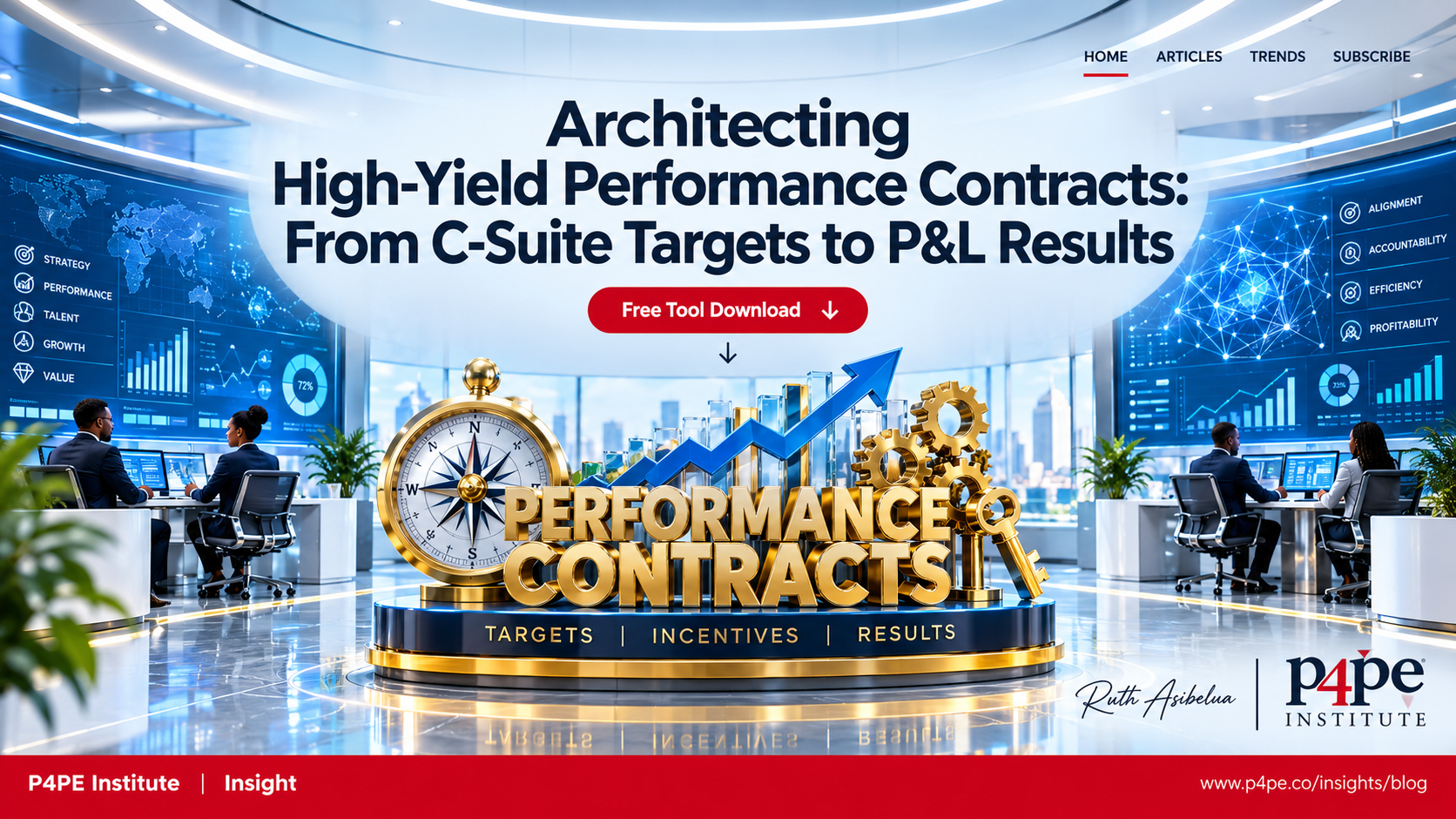
A. CEOs: Your team isn’t underperforming. Your performance contracts are.
When ambitious C-suite targets fail to convert into P&L performance, the breakdown rarely stems from lack of effort. It stems from broken execution architecture. If your cascade stops at senior leadership, you are funding vanity activity while bleeding EBITDA.
B. The Expensive Problem
Across African markets, mid-market enterprises and mid-cap conglomerates lose up to 30% of their operational efficiency through misaligned execution. Board-level mandates for 40% growth routinely shrink to single-digit EBITDA gains because performance targets dilute as they descend the org chart.
When strategic OKRs transform into passive job descriptions at the operational level, the financial toll is immediate. Increased attrition risk among high performers, rising customer acquisition costs, and inflated overhead quickly erosion margins. For a mid-sized enterprise operating out of Lagos or Nairobi, this misalignment represents millions in uncaptured revenue annually. You cannot scale enterprise value when individual outputs fail to tie directly to revenue per employee and predictive growth indicators.
C. Why The Old Way Fails
Traditional performance management relies on annual appraisal cycles and vanity KPIs. Executives often fall into three distinct traps:
- Measuring Activity Over Outcomes: HR departments track completed tasks, attendance, and project milestones instead of net contribution to bottom-line efficiency.
- Disconnected Cascading: C-suite strategy is handed down as top-level mandates without re-architecting individual functional deliverables, leaving operational managers with non-predictive indicators.
- Copy-Pasting Global Templates: Organizations import standard global scorecard templates that ignore local market friction, supply chain volatility, and regulatory realities unique to emerging African ecosystems.
Real HR Transformation requires abandoning cosmetic appraisal forms in favor of precision performance contracts anchored in P&L accountability.
D. The Framework / The Fix
To bridge the gap between strategic intent and operational output, enterprise leaders must implement a four-stage Performance Contract Architecture:
Step 1: Deconstruct P&L Targets into Line-Level Drivers
Begin at the board level. Translate macro financial outcomes (e.g., net revenue margin, return on invested capital) into operational drivers. Map these drivers down to specific functional units. Every role in your organization must directly own a lever that either drives revenue, reduces operational risk, or optimizes cost.
Step 2: Establish Predictive Growth Indicators
Replace lagging metrics with lead indicators. Instead of evaluating sales executives solely on quarterly closed deals (a lagging outcome), contract them on qualified enterprise pipeline velocity and executive contract conversions (predictive metrics). Ensure that every operational lead KPI acts as an early indicator for upcoming quarterly P&L results.
Step 3: Architect Mutual Cascading Contracts
Performance contracts are not top-down directives; they are structural commitments between leaders and operational heads. Draft bilateral agreements specifying explicit inputs, required resources, inter-departmental dependencies, and targeted financial outputs. If Marketing is contracted to generate enterprise leads, Sales must be contractually bound to lead conversion velocity metrics.
Step 4: Institute Data-Driven Review Cadences
Traditional annual reviews are obsolete. Shift to weekly operational pulse checks and monthly quantitative P&L reviews powered by People Analytics. Track variance against target in real-time to identify execution bottlenecks, reallocate capital, and manage talent risks before they affect quarterly EBITDA.
E. What Good Looks Like
A rapidly expanding financial services firm scaling across West Africa was struggling with a 25% discrepancy between projected strategic goals and actual earnings. By overhauling their executive scorecards into high-yield performance contracts, they linked branch operations, risk management, and product design directly to net interest margin and customer retention metrics. Within nine months, revenue per employee grew by 34%, operational waste fell by 18%, and leadership retention reached an all-time high.
F. The Executive Takeaway & CTA
Your strategic vision is only as effective as the contractual clarity behind its execution. When every role holds a direct, measurable stake in predictive growth drivers, P&L results follow naturally.
To help you translate board targets into line-level execution, we built the High-Yield Performance Contract Template [C-Suite to Staff]. It’s the exact tool we use with our clients to drive execution clarity and protect margins. Comment TOOL and I’ll send it directly to your inbox.
