
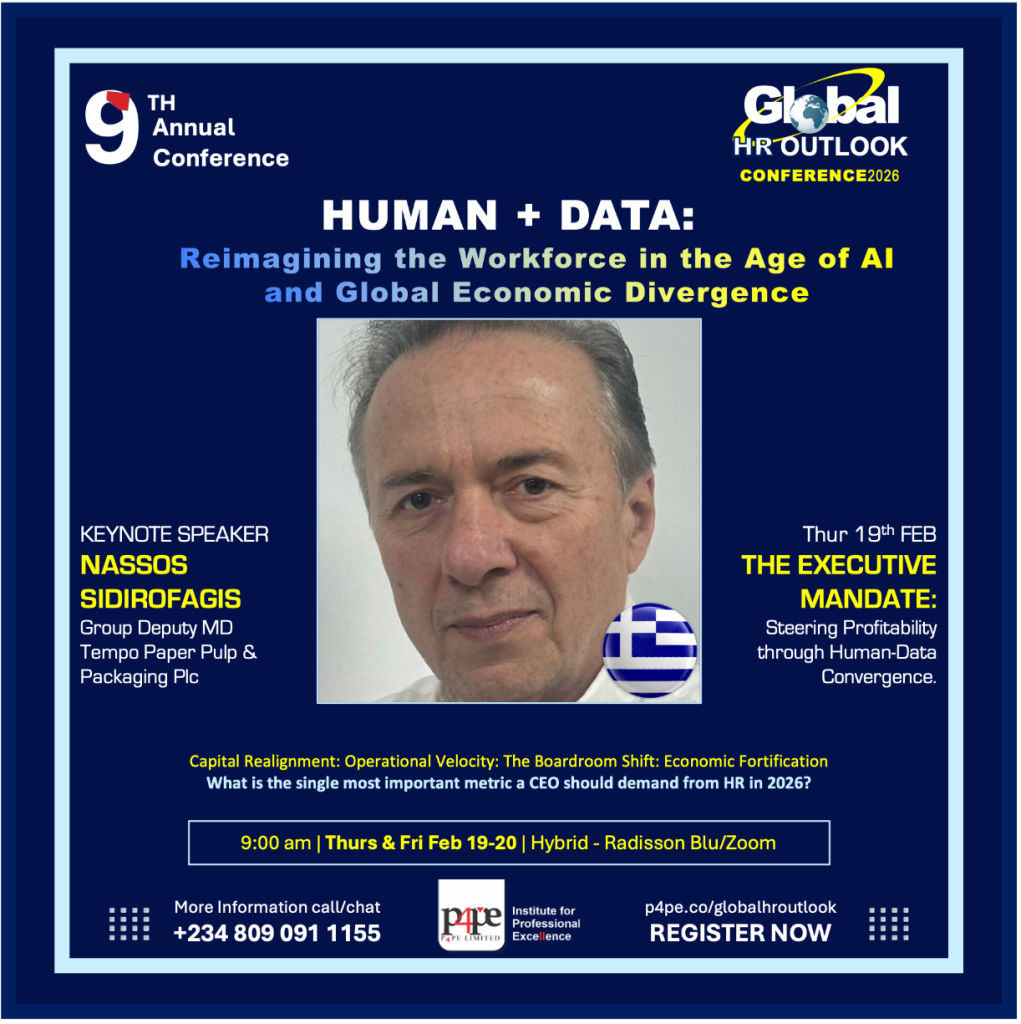
The HR Outlook Conference 2026 brought together global thought leaders to explore the future of work, leadership, and transformation. One of the most compelling sessions was delivered by a seasoned international executive, Nassos Sidirofagis, who offered a rare perspective—not as an HR practitioner, but as HR’s internal customer.
His message was clear: HR must fundamentally transform to remain relevant in a fast-changing, AI-driven world.
Living in “Interesting Times”: Why HR Must Act Now
The keynote began with a powerful reflection: we are living in “interesting times”—a period marked by global uncertainty, economic shifts, and rapid technological advancement.
From geopolitical instability to fluctuating markets and local economic realities, businesses today operate in an environment where:
- Supply chains are fragile
- Economic conditions are unpredictable
- Competition is increasingly global
For organizations, survival depends on speed, adaptability, and strategic alignment—and HR sits at the center of this transformation.
The AI Revolution: Threat or Opportunity?
Artificial Intelligence is no longer a future concept—it is already reshaping industries.
Key insights shared:
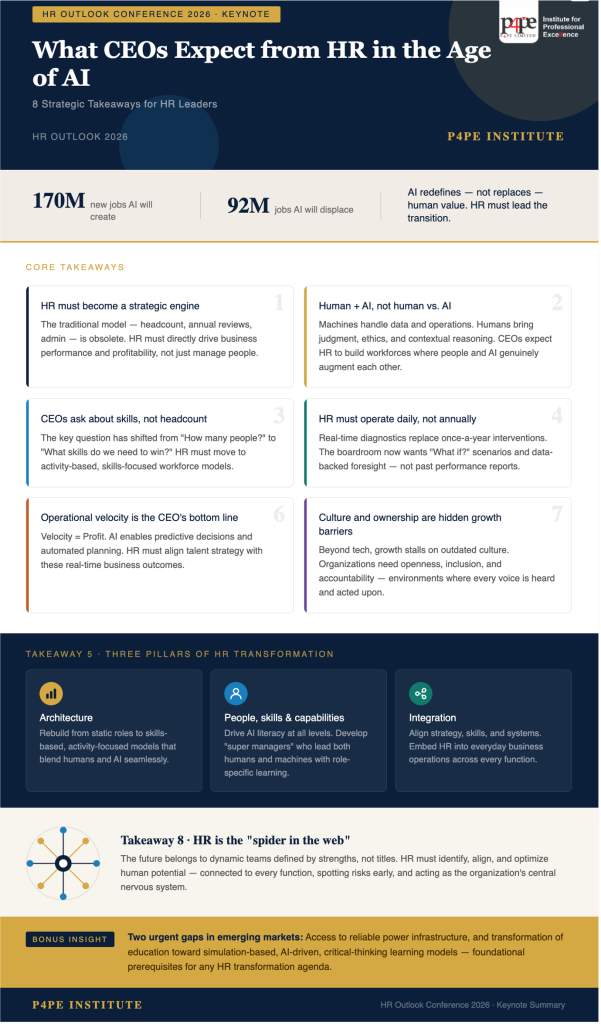
- AI is projected to create 170 million jobs, while 92 million roles may disappear
- Automation is rapidly replacing repetitive and operational roles
- Advanced technologies (like robotics and AI systems) are already performing human tasks at scale
Yet, beyond the numbers lies a deeper reality:
AI is not replacing humans—it is redefining the value of human contribution.
While machines can process data and optimize operations, they cannot:
- Interpret complex human contexts
- Exercise judgment in ambiguous situations
- Apply common sense and ethical reasoning
This reinforces a critical point:
👉 The future of work is human + AI, not human vs AI.
Closing the Gap: Power and Education as Strategic Priorities
To remain competitive globally, organizations—especially in emerging markets—must address two foundational gaps:
- Access to reliable power
- Transformation of education systems
The future workforce must move beyond traditional learning models to embrace:
- Simulation-based learning
- AI-driven education
- Critical thinking development
HR leaders must play a central role in redefining how people learn, adapt, and grow in the workplace.
Redefining HR: From Function to Strategic Engine
One of the most striking messages from the keynote was this:
“HR as we know it today may no longer exist in the future.”
The traditional HR model—focused on annual reviews, headcount, and administrative processes—is becoming obsolete.
Instead, HR must evolve into a dynamic, continuously engaged strategic function.
Three Pillars of HR Transformation
1. Architecture (Rebuilding the System)
- Shift from static roles to activity-based workforce models
- Focus on skills, not just headcount
- Design flexible structures that integrate humans, AI, and hybrid teams
2. People, Skills & Capabilities
- Build AI literacy across all levels
- Move from generic training to role-specific, AI-enabled learning
- Develop leaders into “super managers” who can manage both humans and machines
3. Integration (Making It Work)
- Align strategy, skills, and systems seamlessly
- Ensure continuous interaction—not yearly intervention
- Embed HR into everyday business operations
The Rise of Dynamic HR: Continuous, Not Occasional
The keynote challenged a long-standing HR practice:
“HR cannot intervene once a year—it must operate daily.”
Modern organizations require:
- Real-time workforce insights
- Continuous performance diagnostics
- Ongoing engagement with teams
CEOs are no longer asking:
- “How many people do we need?”
They are asking:
- “What skills do we need to win?”
Operational Velocity: The CEO’s Real Focus
A powerful takeaway from the session was the definition of operational velocity:
Operational velocity = Profit
Speed, efficiency, and precision directly impact revenue.
With AI, organizations can achieve:
- Predictive maintenance
- Real-time decision-making
- Automated planning and logistics
The implication for HR is clear:
👉 HR must align talent strategies with business performance and profitability, not just people management.
Boardroom Shift: From Reporting to Foresight
Traditional boardroom conversations—focused on past performance—are becoming irrelevant.
The future demands:
- Real-time insights
- Scenario-based thinking (“What if?” analysis)
- Data-backed strategic decisions
HR leaders must come prepared not with reports, but with:
- Scenarios
- Insights
- Strategic recommendations
Culture and Leadership: The Hidden Barriers
Beyond technology, the keynote highlighted two critical barriers to growth:
1. Culture
- Organizational culture must evolve to encourage openness, inclusion, and collaboration
- Biases and structural limitations must be addressed
2. Ownership Mindset
- Employees must be empowered to think, contribute, and take initiative
- Organizations must create environments where voices are heard and valued
The Future of Work: Teams Over Titles
One of the most forward-looking insights was the idea that:
Titles may disappear—teams will define the future of work.
In this model:
- Individuals contribute based on strengths and expertise
- Teams are built around capabilities, not hierarchy
- Collaboration replaces rigid structures
HR’s role becomes identifying, aligning, and optimizing human potential within dynamic teams.
The New Expectation: HR as the “Spider in the Web”
The keynote used a powerful metaphor:
HR must become the “spider in the web”—connected to every part of the organization.
This means:
- Being present across all functions
- Identifying risks and opportunities early
- Driving alignment between people, strategy, and performance
HR is no longer a support function—it is the central nervous system of the organization.
Key Takeaways for HR Leaders
- Embrace change boldly—without fear
- Focus on skills, not just roles
- Build AI literacy across the workforce
- Move from annual processes to continuous engagement
- Align HR strategies with business outcomes
- Develop leaders who can manage both humans and AI
- Redefine culture to enable ownership and innovation
About the Keynote Speaker
The keynote speaker, Nassos Sidirofagis, is a Group Deputy Managing Director at Temple Group (Paper, Pulp & Packaging), with over two decades of international leadership experience across Africa, Europe, the United Kingdom, and the United States.
With a background in Mechanical Engineering and Finance (MBA), he brings a unique blend of technical expertise and business strategy. His career spans leadership roles in manufacturing and global operations, where he has driven operational excellence, high-performance cultures, and large-scale transformation initiatives.
Known for his practical, results-driven approach, he offers a valuable perspective on how HR can better align with executive priorities in today’s rapidly evolving business landscape.
Looking Ahead: Join Us in 2027
The HR Outlook Conference 2026 has once again highlighted the urgency for HR transformation in a world shaped by AI, data, and global change.
As we look ahead, the conversation continues.
Join us at the Global HR Outlook Conference 2027 to gain deeper insights, connect with industry leaders, and equip yourself with the tools needed to lead in the future of work.
The future of HR is here—are you ready to lead it?
Register in advance: www.p4pe.co/globalhroutlook/
