A. The Hook
CHROs: If you pitch HR as a cost center, the board will treat it like one.
Every year, HR leaders ask for budget to hire, train, digitise, engage, retain and develop people. But when the conversation reaches the Board, one question often changes everything: “What will this investment do for revenue, margin, risk or growth?”
If you cannot answer that in financial terms, your business case is already weak.
B. The Expensive Problem
The problem is not that Boards do not value people.
The problem is that most HR investment cases are written in the language of HR while Boards make decisions in the language of business.
“Leadership development.”
“Employee engagement.”
“HR technology.”
“Additional headcount.”
“Learning and development.”
These may all be legitimate investments. But they are not, by themselves, business outcomes.
A CFO sees cost.
A CEO sees competing priorities.
The Board sees an allocation decision.
And the question becomes: Why should we put another ₦100 million into this instead of sales, technology, expansion or working capital?
This is where many CHROs lose the budget battle.
The financial consequences can be significant. Labour is one of the largest controllable cost lines in many organisations, while poor workforce decisions can simultaneously affect productivity, customer experience, revenue generation and risk.
For example, replacing a senior employee can cost substantially more than salary alone when recruitment, onboarding, lost productivity, management time and institutional knowledge are included.
And the cost of weak leadership is even harder to see because it appears across multiple P&L lines.
The strategic CHRO therefore needs to move beyond “HR costs us X” toward “this people investment protects or creates Y.”
That is the language of the Board.
C. Why The Old Way Fails
1. You measure activity instead of economic impact
HR reports often focus on training hours, vacancies filled, engagement scores, HR transactions and programme participation.
These metrics can tell you what HR did.
They do not necessarily tell the Board what the business gained.
2. You present HR initiatives in isolation
A leadership programme is presented as a leadership programme.
A recruitment project is presented as recruitment.
A workforce analytics initiative is presented as technology.
But the Board is managing one organisation.
It wants to understand how these investments affect revenue, cost, risk and strategic execution.
3. You calculate ROI too late
Many HR teams only attempt to demonstrate value after an initiative has been approved.
That reverses the process.
The business case should begin with the economic problem, establish the baseline, quantify the opportunity, identify the intervention and then define how value will be measured.
That turns HR from a budget requester into a business partner.
D. The Framework / The Fix
Here is the BOARD HR Investment Framework—a practical way to build a financial case the Board can understand.
Step 1: Start With the Business Problem
Do not start with your HR programme.
Start with the business problem.
Instead of:
“We need a new leadership development programme.”
Frame it as:
“Our leadership pipeline is insufficient to support the planned expansion into three new markets.”
Instead of:
“We need more HR technology.”
Frame it as:
“Our current workforce processes create delays, manual cost and poor workforce visibility that are affecting management decision-making.”
The first statement asks for money.
The second identifies a business problem that requires investment.
Step 2: Put a Financial Value on the Problem
This is where many HR business cases become weak.
Quantify the current cost.
Consider:
Revenue: What revenue is being delayed, lost or constrained?
Cost: What unnecessary operating costs are being created?
Productivity: How much productive capacity is being lost?
Risk: What is the potential financial exposure?
Time: How much management time is being consumed?
Growth: What opportunity cannot be captured because of the people constraint?
For example, if critical vacancies are taking 90 days to fill and each vacant commercial role is estimated to forgo ₦X in monthly gross contribution, the vacancy is not simply a recruitment metric.
It is a revenue leakage issue.
Step 3: Connect the Investment to a Business Lever
Every major HR investment should clearly connect to at least one of five levers:
1. Revenue Growth
Can the investment increase sales capacity, customer retention, market entry or revenue per employee?
2. Cost Reduction
Can it reduce overtime, unwanted attrition, recruitment costs, manual processes or workforce inefficiency?
3. Risk Reduction
Can it reduce compliance exposure, leadership risk, operational failure or critical-person dependency?
4. Productivity
Can it improve output per employee, time-to-productivity or management effectiveness?
5. Strategic Agility
Can it help the organisation scale, redeploy talent or execute strategy faster?
If an HR initiative cannot connect to one of these levers, its business case needs more work.
Step 4: Build the Financial Model
Now quantify the expected return.
A simple HR investment model can include:
Investment Cost
Programme + technology + people + implementation + external support.
Financial Benefit
Revenue gained + cost avoided + productivity value + risk exposure reduced.
Then calculate:
Net Benefit = Financial Benefit – Investment Cost
And:
ROI = Net Benefit ÷ Investment Cost × 100
But do not stop at ROI.
Boards also care about:
- Payback period
- EBITDA impact
- Cash impact
- Revenue per employee
- Cost per employee
- Cost of attrition
- Time-to-productivity
- Scenario sensitivity
And be conservative.
A business case that promises 300% ROI with weak assumptions will lose credibility faster than one showing a defensible 35%.
Step 5: Present Three Scenarios
Do not give the Board only one number.
Give them choices.
Conservative: What happens if only 50% of the expected benefit is achieved?
Base Case: What is the most realistic outcome?
Upside: What happens if execution exceeds expectations?
This allows the Board to see both opportunity and risk.
It also demonstrates that you understand investment discipline.
The strongest CHROs do not ask the Board to “believe in HR.”
They give the Board enough evidence to make an investment decision.
That is a fundamental shift in HR Transformation.
E. What Good Looks Like
Consider a company experiencing high turnover among critical commercial roles.
Instead of presenting the Board with an “employee retention programme,” the CHRO identifies the financial impact of unwanted attrition: recruitment costs, vacancy periods, lost customer relationships, onboarding time and lost productivity.
The proposed intervention costs ₦40 million.
The conservative scenario estimates ₦60 million in annual value protection.
The base case estimates ₦100 million.
The upside is ₦140 million.
Now the conversation is different.
The Board is no longer approving an HR programme.
It is evaluating an investment with a measurable financial return.
F. The Executive Takeaway
Your Board does not need HR to become Finance.
But it does need HR to understand the economics of its decisions.
The CHRO who can connect workforce investments to revenue, EBITDA, productivity, risk and strategic execution earns a very different position at the Board table.
HR becomes harder to cut when the business can see what it costs not to invest.
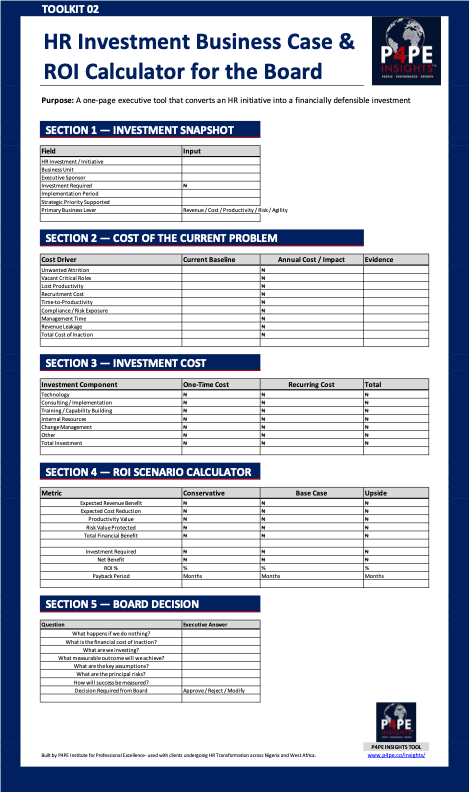
To help you build that case, we created the HR Investment Business Case & ROI Calculator for the Board.
It gives you a practical structure for quantifying the problem, modelling investment scenarios, calculating ROI and presenting the business case in language your CEO, CFO and Board can act on.
Access the TOOL below: